
Buena Park Wood Flooring has helped owners replace carpet with hardwood in Buena Park, CA for 20+ years, serving surrounding cities including La Palma, La Mirada, Cypress, Cerritos, Stanton. We pull the carpet, find out what is underneath, and then either restore the wood floor that was already there or install new hardwood with clean transitions to every room.
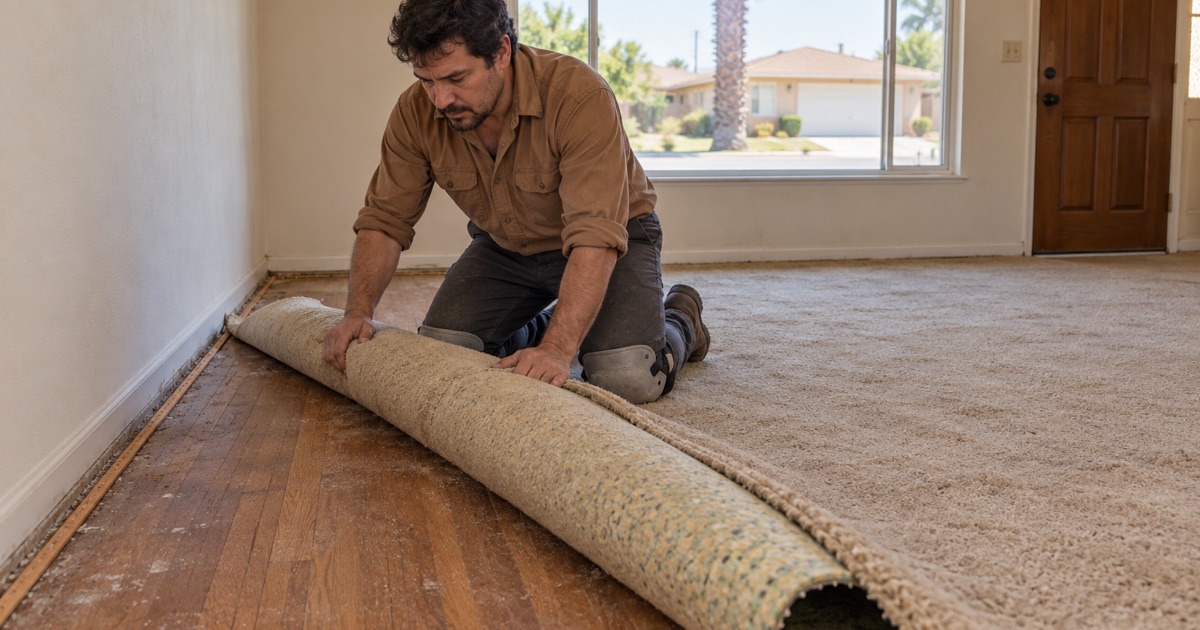
The first question is what the carpet has been hiding. Many houses built in the 1950s and 1960s have oak strip flooring under wall-to-wall carpet that was added later, and restoring it usually costs far less than buying a new floor. Other houses have a plywood subfloor or a concrete slab, which need a new floor instead.
Either way, we check before you commit. A corner lifted in a closet, a look at the floor at a heating register, and moisture readings tell us what you have, and the estimate is written from that rather than from a guess.
When There Is Hardwood Under the Carpet
Assessing Oak Strip Board by Board
Oak strip that has been under carpet is usually well preserved, but it can have water stains near doors, pet stains, and a ring of carpet tack strip holes around each room. We walk the floor board by board, marking what needs replacing, so the estimate reflects the real condition rather than an assumption that the floor is ruined.
We also look at where the floor was cut or patched for heating registers, old wall positions or a removed floor furnace. Those areas can be filled with matching strips woven into the surrounding boards, so the restored floor runs unbroken from wall to wall.
Removing Staples, Tack Strip and Pad Glue
Carpet installers fasten pad with flooring staples and carpet with tack strip nailed around the edges. We pull every staple and strip, fill the holes with a color-matched filler, and scrape off any pad adhesive by hand, since glue and staples destroy sandpaper and gouge the wood.
Sanding and Refinishing the Original Floor
Once cleaned and repaired, the floor is sanded with a drum sander, edger and orbital sander through a full grit sequence, then stained if you want color and finished with a product that meets the South Coast VOC limits. The result is often a floor that looks close to new for a fraction of the cost.
Oak that has spent decades under carpet has often stayed lighter than oak that was exposed, with a darker band where sun reached the edges. Sanding takes it back to fresh wood, and test patches of stain on the sanded floor let you choose the final color in your own light.
When There Is No Hardwood Underneath
Hardwood on a Plywood Subfloor
Where carpet sat on a plywood subfloor, we check for soft spots and loose areas and repair them before installing. Solid hardwood can be nailed directly to a sound plywood subfloor, giving a floor that can be sanded and refinished many times over its life.
Plywood under carpet is sometimes stained near bathrooms or pet areas. We check those spots with a moisture meter and by pressing on them, and replace any section that is soft before the new hardwood goes down over it.
Hardwood Over a Concrete Slab
On a slab, engineered hardwood is usually the better choice, either glued down or floated over an underlayment. We test the slab for moisture first, using an ASTM F2170 in-situ relative humidity test or a calcium chloride test, and record the readings before ordering any material.
Carpet tack strip nails leave holes in the concrete around the room, and pad adhesive may remain on the slab. We clean the slab back to a sound surface, fill low areas and grind high spots, so the new floor is flat and the adhesive bonds properly.
Old Adhesive and Tile Under the Carpet
Some houses have old vinyl or 9x9 floor tile under the carpet, set in black mastic. In older houses, that tile and adhesive can contain asbestos, so we arrange a survey before anything is scraped or ground, rather than disturbing it and finding out afterward.
Transitions, Doors and Stairs
Height Changes at Doorways
A new hardwood floor rarely sits at exactly the same height as the tile, vinyl or remaining carpet it meets at a doorway. We plan each transition with the right reducer strip, T-molding or threshold, so the floor steps down smoothly without a lip to trip on.
Where hardwood meets carpet that is staying, a tack strip set back from the wood edge lets the carpet tuck neatly against it. Where it meets tile, we match the transition color to the wood so the joint reads as deliberate rather than patched.
Doors, Baseboard and Shoe Molding
Interior doors hung for carpet sometimes need trimming to clear a hard floor. We remove and reinstall baseboard or add shoe molding to cover the expansion gap at the walls, leaving a finished edge in every room.
Carpeted Stairs
If the stairs are carpeted too, they can be converted with new hardwood treads, risers and nosings matched to the new floor. We price the stairs per tread and riser so the cost is separate and clear.
Stairs are usually the last part of the job, so the upstairs and downstairs floors are already down and the nosing at the top landing can be fitted to the finished height. That order keeps the transition from hallway to staircase flush.
Living With the Change
Sound and Comfort
Hardwood is harder and louder underfoot than carpet, especially upstairs. Area rugs soften sound in living spaces, and in condos an acoustic underlayment with a published delta IIC rating is often required by the association before hardwood can replace carpet.
Felt pads under furniture legs and a rug under the dining table cut down on scraping sounds as well as scratches. In bedrooms, a rug beside the bed gives a soft place to step first thing in the morning while the rest of the room keeps the look of wood.
Cleaning and Allergies
Many owners replace carpet with hardwood because it does not hold dust, pet hair and allergens the way carpet does. A hardwood floor needs only regular dry dusting and an occasional damp mop, and it can be refinished when it wears instead of being thrown away.
- 20+ Years in Wood Flooring
- Itemized Written Estimates
- Lead-Safe Sanding